
This class implements the search algorithms from the causalDisco package, which wraps and adds temporal order to pcalg algorithms. It allows to set the data, sufficient statistics, test, score, and algorithm.
Public fields
dataA
data.frameholding the data set currently attached to the search object. Can be set withset_data().scoreA function that will be used to build the score, when data is set. Can be set with
$set_score(). Recognized values are:"tbic"- Temporal BIC score for Gaussian data. See TemporalBIC."tbdeu"- Temporal BDeu score for discrete data. See TemporalBDeu.
testA function that will be used to test independence. Can be set with
$set_test(). Recognized values are:"fisher_z"- Fisher Z test for Gaussian data. Seecor_test()."fisher_z_twd"- Fisher Z test for Gaussian data with test-wise deletion. Seemicd::gaussCItwd()."fisher_z_mi"- Fisher Z test for Gaussian data with multiple imputation. Seemicd::gaussCItestMI()."reg"- Regression test for discrete or binary data. Seereg_test()."g_square"- G square test for discrete data. Seepcalg::binCItest()andpcalg::disCItest()."g_square_twd"- G square test for discrete data with test-wise deletion. Seemicd::disCItwd()."g_square_mi"- G square test for discrete data with multiple imputation. Seemicd::disMItest()."conditional_gaussian"- Test for conditional independence in mixed data. Seemicd::mixCItest()."conditional_gaussian_twd"- Test for conditional independence in mixed data with test-wise deletion. Seemicd::mixCItwd()."conditional_gaussian_mi"- Test for conditional independence in mixed data with multiple imputation. Seemicd::mixMItest().
algA function that will be used to run the search algorithm. Can be set with
$set_alg(). Recognized values are:"tfci"- TFCI algorithm. Seetfci()."tges"- TGES algorithm. Seetges()."tpc"- TPC algorithm. Seetpc().
Can also be a user-defined function; see
$set_alg()for details.paramsA list of parameters for the test and algorithm. Can be set with
$set_params(). TODO: not secure yet in terms of distributing arguments. Use with caution.suff_statSufficient statistic. The format and contents of the sufficient statistic depends on which test is being used.
knowledgeA
Knowledgeobject holding background knowledge.
Methods
CausalDiscoSearch$set_test()
Sets the test for the search algorithm.
Arguments
method![[Experimental]](figures/lifecycle-experimental.svg)
A string specifying the type of test to use.
Can also be a user-defined function with signature
function(x, y, conditioning_set, suff_stat), wherexandyare the variables being tested for independence,conditioning_setis the conditioning set, andsuff_statis the sufficient statistic for the test. If a user-defined function is provided, thensuff_stat_funmust also be provided, which is a function that should take the data as input and returns a sufficient statistic for the test. Optionally, the signature of the user-defined test function can also include anargsparameter, which is a list of additional arguments to pass to the test function. Ifargsis provided, then the test function should have the signaturefunction(x, y, conditioning_set, suff_stat, args), and theargsparameter will be passed to the test function.EXPERIMENTAL: user-defined tests syntax are subject to change.
alphaSignificance level for the test.
suff_stat_funA function that takes the data as input and returns a sufficient statistic for the test. Only needed if
methodis a user-defined function.argsA list of additional arguments to pass to the test. Only needed if
methodis a user-defined function with anargsparameter in its signature.
CausalDiscoSearch$set_score()
Sets the score for the search algorithm.
Usage
CausalDiscoSearch$set_score(method, params = list())CausalDiscoSearch$set_alg()
Sets the algorithm for the search.
Usage
CausalDiscoSearch$set_alg(method, type = c("constraint", "score"), args = NULL)Arguments
methodA string specifying the type of algorithm to use.
Can also be a user-defined function implementing a full search algorithm. Its required signature depends on
type:type = "constraint"(default) - signaturefunction(data, knowledge, suff_stat, ...), analogous totpc_run()andtfci_run().type = "score"- signaturefunction(score, ...), analogous totges_run().
Optionally, the function's signature can also include an
argsparameter, which is a list of additional arguments to pass to the algorithm function. Ifargsis provided, the function should have the signaturefunction(data, knowledge, suff_stat, args)(orfunction(score, args)fortype = "score"), and theargsparameter will be passed to the algorithm function.EXPERIMENTAL: user-defined algorithm syntax is subject to change.
typeOnly used if
methodis a user-defined function. One of"constraint"(default) or"score", specifying whether the algorithm is constraint-based (called withdata/knowledge/suff_stat) or score-based (called withscore).argsA list of additional arguments to pass to the algorithm. Only needed if
methodis a user-defined function with anargsparameter in its signature.
CausalDiscoSearch$set_knowledge()
Sets the background knowledge for the search with a Knowledge object.
Usage
CausalDiscoSearch$set_knowledge(
  kn,
  directed_as_undirected = lifecycle::deprecated()
)![[Deprecated]](figures/lifecycle-deprecated.svg)
Examples
# Generally, we do not recommend using the R6 classes directly, but rather
# use the disco() or any method function, for example pc(), instead.
data(tpc_example)
# background knowledge (tiered knowledge)
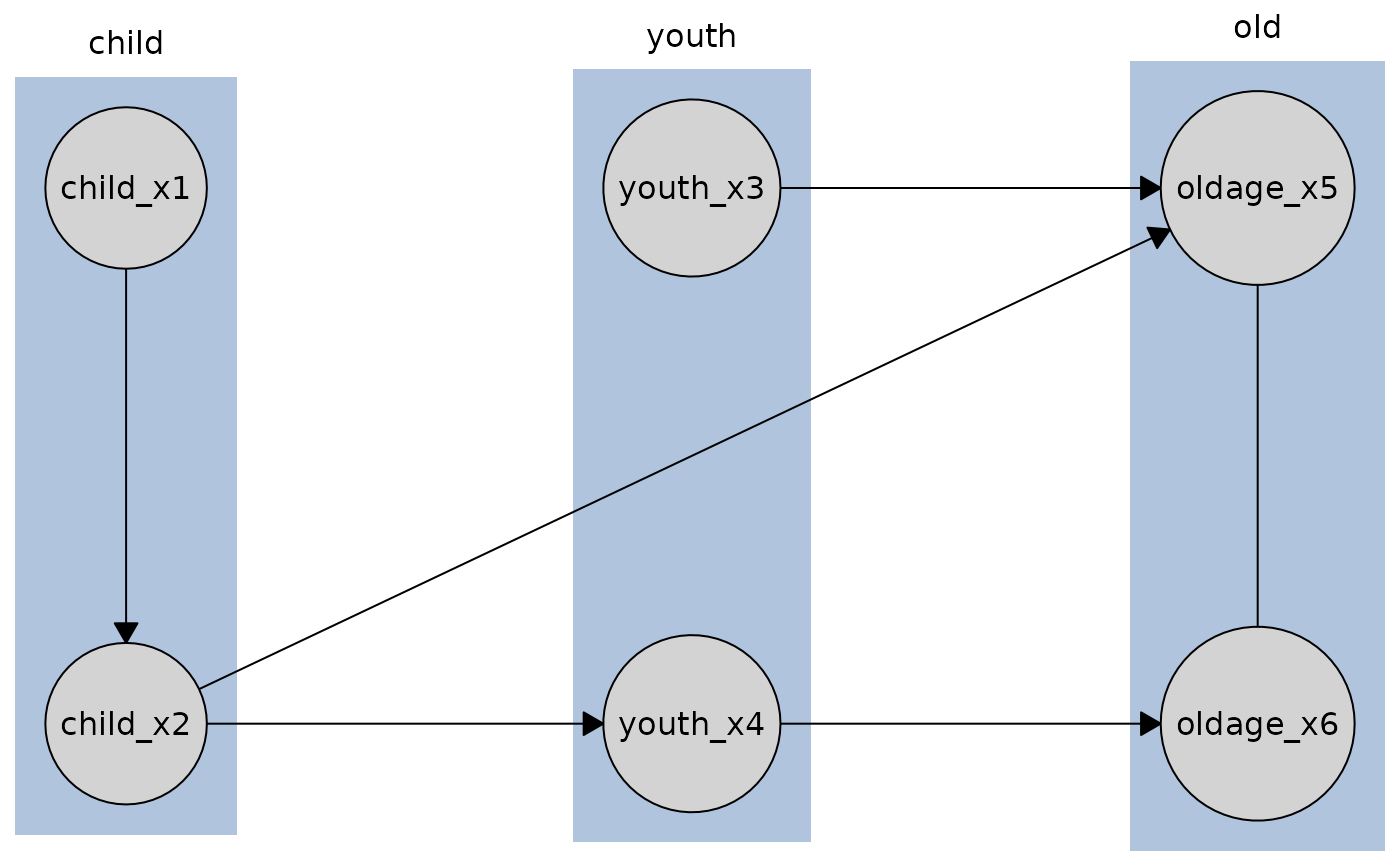
kn <- knowledge(
tpc_example,
tier(
child ~ starts_with("child"),
youth ~ starts_with("youth"),
old ~ starts_with("oldage")
)
)
# Recommended (TPC example):
my_tpc <- tpc(engine = "causalDisco", test = "fisher_z", alpha = 0.05)
result <- disco(data = tpc_example, method = my_tpc, knowledge = kn)
plot(result)
 # or
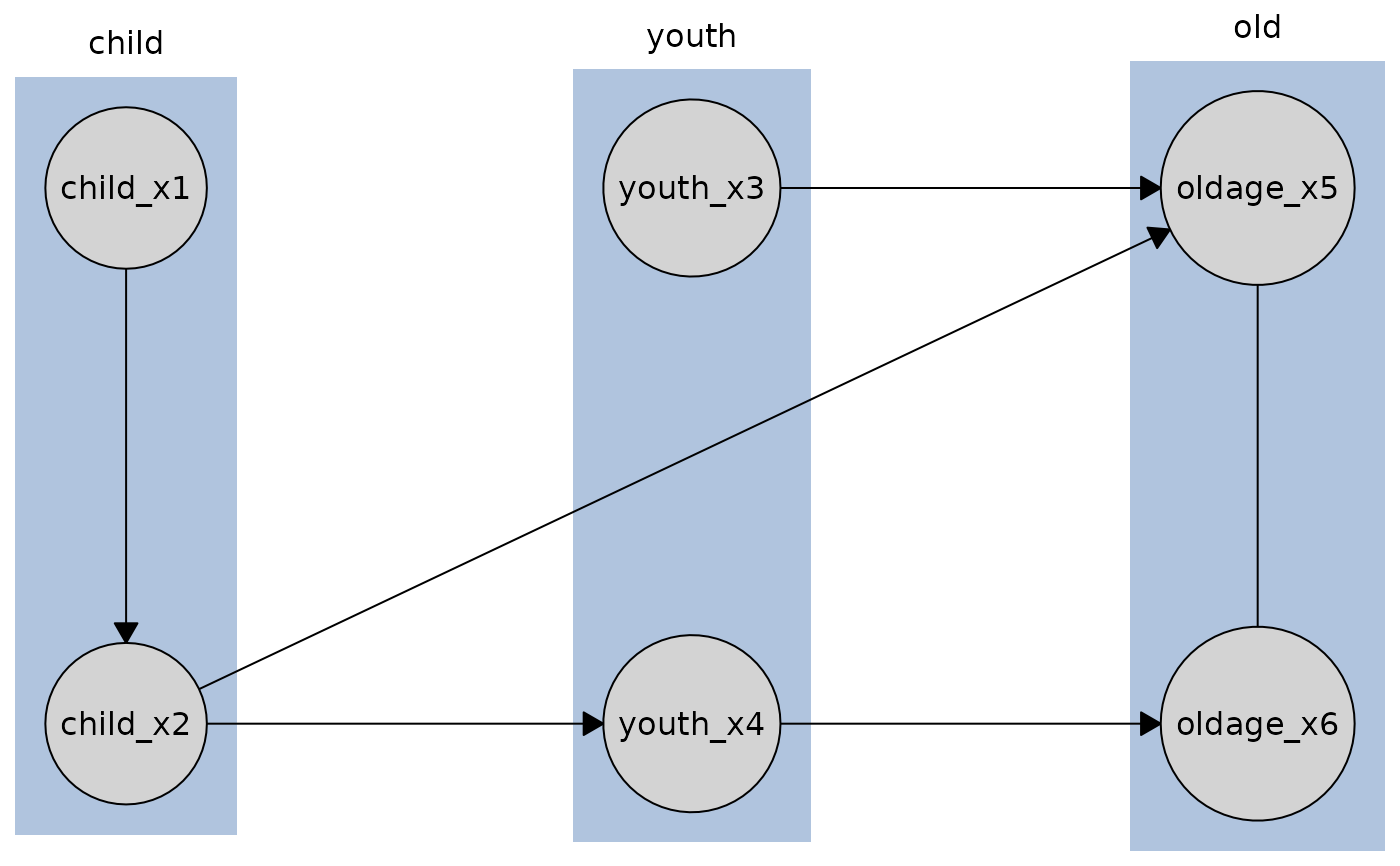
my_tpc <- my_tpc |>
set_knowledge(kn)
result <- my_tpc(tpc_example)
plot(result)
# or
my_tpc <- my_tpc |>
set_knowledge(kn)
result <- my_tpc(tpc_example)
plot(result)
 # Using R6 class:
# --- Constraint-based: TPC ----------------------------------------------------
s_tpc <- CausalDiscoSearch$new()
s_tpc$set_params(list(verbose = FALSE))
s_tpc$set_test("fisher_z", alpha = 0.2)
s_tpc$set_alg("tpc")
s_tpc$set_knowledge(kn)
s_tpc$set_data(tpc_example)
res_tpc <- s_tpc$run_search()
print(res_tpc)
#> <Disco UNKNOWN: 6 nodes | 6 edges | Knowledge: 3 tiers>
#> Learned graph:
#> nodes: child_x2, child_x1, youth_x4, youth_x3, oldage_x6, oldage_x5
#> edges: child_x1---child_x2, child_x2-->oldage_x5, child_x2-->youth_x4
#> oldage_x5-->oldage_x6, youth_x3-->oldage_x5, youth_x4-->oldage_x6
#> Knowledge:
#> tier(child): child_x1, child_x2
#> tier(youth): youth_x3, youth_x4
#> tier(old): oldage_x5, oldage_x6
# Switch to TFCI on the same object (reuses suff_stat/test)
s_tpc$set_alg("tfci")
res_tfci <- s_tpc$run_search()
print(res_tfci)
#> <Disco UNKNOWN: 6 nodes | 6 edges | Knowledge: 3 tiers>
#> Learned graph:
#> nodes: child_x2, child_x1, youth_x4, youth_x3, oldage_x6, oldage_x5
#> edges: child_x2o-ochild_x1, child_x2o->oldage_x5, child_x2o->youth_x4
#> oldage_x5-->oldage_x6, youth_x3o->oldage_x5, youth_x4-->oldage_x6
#> Knowledge:
#> tier(child): child_x1, child_x2
#> tier(youth): youth_x3, youth_x4
#> tier(old): oldage_x5, oldage_x6
# --- Score-based: TGES --------------------------------------------------------
s_tges <- CausalDiscoSearch$new()
s_tges$set_score("tbic") # Gaussian temporal score
s_tges$set_alg("tges")
s_tges$set_data(tpc_example, set_suff_stat = FALSE) # suff stat not used for TGES
s_tges$set_knowledge(kn)
res_tges <- s_tges$run_search()
print(res_tges)
#> <Disco PDAG: 6 nodes | 6 edges>
#> nodes: child_x2, child_x1, youth_x4, youth_x3, oldage_x6, oldage_x5
#> edges: child_x1---child_x2, child_x2-->oldage_x5, child_x2-->youth_x4
#> oldage_x5-->oldage_x6, youth_x3-->oldage_x5, youth_x4-->oldage_x6
# --- Custom (user-defined) algorithm: constraint-based -----------------------
my_alg <- function(data, knowledge, suff_stat) {
tpc_run(
data = data,
knowledge = knowledge,
suff_stat = suff_stat,
test = reg_test
)
}
s_custom <- CausalDiscoSearch$new()
s_custom$set_test("reg")
s_custom$set_knowledge(kn)
s_custom$set_alg(my_alg) # type = "constraint" by default
s_custom$set_data(tpc_example)
res_custom <- s_custom$run_search()
print(res_custom)
#> <Disco UNKNOWN: 6 nodes | 6 edges | Knowledge: 3 tiers>
#> Learned graph:
#> nodes: child_x2, child_x1, youth_x4, youth_x3, oldage_x6, oldage_x5
#> edges: child_x1---child_x2, child_x2-->oldage_x5, child_x2-->youth_x4
#> oldage_x5-->oldage_x6, youth_x3-->oldage_x5, youth_x4-->oldage_x6
#> Knowledge:
#> tier(child): child_x1, child_x2
#> tier(youth): youth_x3, youth_x4
#> tier(old): oldage_x5, oldage_x6
# --- Intentional error demonstrations ----------------------------------------
# run_search() without setting an algorithm
try(CausalDiscoSearch$new()$run_search(tpc_example))
#> Error : Test must be set before sufficient statistic.
# set_suff_stat() requires data and test first
s_err <- CausalDiscoSearch$new()
try(s_err$set_suff_stat()) # no data & no test
#> Error : Data must be set before sufficient statistic.
s_err$set_data(tpc_example, set_suff_stat = FALSE)
try(s_err$set_suff_stat()) # no test
#> Error : Test must be set before sufficient statistic.
# unknown test / score / algorithm
try(CausalDiscoSearch$new()$set_test("not_a_test"))
#> Error : Unknown method: not_a_test
try(CausalDiscoSearch$new()$set_score("not_a_score"))
#> Error : Unknown score type using causalDisco engine: not_a_score
try(CausalDiscoSearch$new()$set_alg("not_an_alg"))
#> Error : Unknown method type using causalDisco engine: not_an_alg
# set_knowledge() requires a `Knowledge` object
try(CausalDiscoSearch$new()$set_knowledge(list(not = "Knowledge")))
#> Error : Input must be a knowledge instance.
# Using R6 class:
# --- Constraint-based: TPC ----------------------------------------------------
s_tpc <- CausalDiscoSearch$new()
s_tpc$set_params(list(verbose = FALSE))
s_tpc$set_test("fisher_z", alpha = 0.2)
s_tpc$set_alg("tpc")
s_tpc$set_knowledge(kn)
s_tpc$set_data(tpc_example)
res_tpc <- s_tpc$run_search()
print(res_tpc)
#> <Disco UNKNOWN: 6 nodes | 6 edges | Knowledge: 3 tiers>
#> Learned graph:
#> nodes: child_x2, child_x1, youth_x4, youth_x3, oldage_x6, oldage_x5
#> edges: child_x1---child_x2, child_x2-->oldage_x5, child_x2-->youth_x4
#> oldage_x5-->oldage_x6, youth_x3-->oldage_x5, youth_x4-->oldage_x6
#> Knowledge:
#> tier(child): child_x1, child_x2
#> tier(youth): youth_x3, youth_x4
#> tier(old): oldage_x5, oldage_x6
# Switch to TFCI on the same object (reuses suff_stat/test)
s_tpc$set_alg("tfci")
res_tfci <- s_tpc$run_search()
print(res_tfci)
#> <Disco UNKNOWN: 6 nodes | 6 edges | Knowledge: 3 tiers>
#> Learned graph:
#> nodes: child_x2, child_x1, youth_x4, youth_x3, oldage_x6, oldage_x5
#> edges: child_x2o-ochild_x1, child_x2o->oldage_x5, child_x2o->youth_x4
#> oldage_x5-->oldage_x6, youth_x3o->oldage_x5, youth_x4-->oldage_x6
#> Knowledge:
#> tier(child): child_x1, child_x2
#> tier(youth): youth_x3, youth_x4
#> tier(old): oldage_x5, oldage_x6
# --- Score-based: TGES --------------------------------------------------------
s_tges <- CausalDiscoSearch$new()
s_tges$set_score("tbic") # Gaussian temporal score
s_tges$set_alg("tges")
s_tges$set_data(tpc_example, set_suff_stat = FALSE) # suff stat not used for TGES
s_tges$set_knowledge(kn)
res_tges <- s_tges$run_search()
print(res_tges)
#> <Disco PDAG: 6 nodes | 6 edges>
#> nodes: child_x2, child_x1, youth_x4, youth_x3, oldage_x6, oldage_x5
#> edges: child_x1---child_x2, child_x2-->oldage_x5, child_x2-->youth_x4
#> oldage_x5-->oldage_x6, youth_x3-->oldage_x5, youth_x4-->oldage_x6
# --- Custom (user-defined) algorithm: constraint-based -----------------------
my_alg <- function(data, knowledge, suff_stat) {
tpc_run(
data = data,
knowledge = knowledge,
suff_stat = suff_stat,
test = reg_test
)
}
s_custom <- CausalDiscoSearch$new()
s_custom$set_test("reg")
s_custom$set_knowledge(kn)
s_custom$set_alg(my_alg) # type = "constraint" by default
s_custom$set_data(tpc_example)
res_custom <- s_custom$run_search()
print(res_custom)
#> <Disco UNKNOWN: 6 nodes | 6 edges | Knowledge: 3 tiers>
#> Learned graph:
#> nodes: child_x2, child_x1, youth_x4, youth_x3, oldage_x6, oldage_x5
#> edges: child_x1---child_x2, child_x2-->oldage_x5, child_x2-->youth_x4
#> oldage_x5-->oldage_x6, youth_x3-->oldage_x5, youth_x4-->oldage_x6
#> Knowledge:
#> tier(child): child_x1, child_x2
#> tier(youth): youth_x3, youth_x4
#> tier(old): oldage_x5, oldage_x6
# --- Intentional error demonstrations ----------------------------------------
# run_search() without setting an algorithm
try(CausalDiscoSearch$new()$run_search(tpc_example))
#> Error : Test must be set before sufficient statistic.
# set_suff_stat() requires data and test first
s_err <- CausalDiscoSearch$new()
try(s_err$set_suff_stat()) # no data & no test
#> Error : Data must be set before sufficient statistic.
s_err$set_data(tpc_example, set_suff_stat = FALSE)
try(s_err$set_suff_stat()) # no test
#> Error : Test must be set before sufficient statistic.
# unknown test / score / algorithm
try(CausalDiscoSearch$new()$set_test("not_a_test"))
#> Error : Unknown method: not_a_test
try(CausalDiscoSearch$new()$set_score("not_a_score"))
#> Error : Unknown score type using causalDisco engine: not_a_score
try(CausalDiscoSearch$new()$set_alg("not_an_alg"))
#> Error : Unknown method type using causalDisco engine: not_an_alg
# set_knowledge() requires a `Knowledge` object
try(CausalDiscoSearch$new()$set_knowledge(list(not = "Knowledge")))
#> Error : Input must be a knowledge instance.