
causalDisco provides a unified interface for causal discovery on observational data. It wraps multiple causal discovery backends under a common, consistent syntax.
Motivation
Causal discovery methods exist in many ecosystems, for example in bnlearn, pcalg, or Tetrad, but their APIs vary widely.
causalDisco unifies them under one clear grammar, making it easy to compare results, switch algorithms, and focus on scientific questions rather than package quirks.
Time to hit the disco 🪩
Available algorithms
causalDisco provides the following causal discovery algorithms, grouped by methodological class, with the supported engines and output graph class for each (function identifiers given in parentheses).

Installation
Install causalDisco
You can install the stable version of causalDisco from CRAN with:
install.packages("causalDisco")or the development version of causalDisco from GitHub using pak:
pak::pak("disco-coders/causalDisco")If you want to use algorithms from Tetrad, you also need to install the suggested dependency rJava (and a Java JDK >= 21). See the instructions below for setting up Java and Tetrad.
Installing Java / JDK
causalDisco provides an interface to the Java library Tetrad for causal discovery algorithms. To use algorithms from Tetrad you need to install a Java Development Kit (JDK) >= 21. We recommend Eclipse Temurin (OpenJDK), available at https://adoptium.net/en-GB/temurin/releases. When using the installer from the Temurin website, make sure to select the option to set the JAVA_HOME environment variable during installation, so rJava correctly detects the Java installation.
For a simpler setup, we recommend using the rJavaEnv package, which provides a convenient function to install Java and configure the environment automatically for rJava. You can install Java using the rJavaEnv::java_quick_install() function:
# Use the development version of rJavaEnv from GitHub
# pak::pak("e-kotov/rJavaEnv")
rJavaEnv::java_quick_install(version = 25, distribution = "Temurin")
Once you have Java JDK set up correctly, the current supported version of Tetrad can then be installed by calling
causalDisco::install_tetrad()To verify everything is set up correctly you can run verify_tetrad():
causalDisco::verify_tetrad()
#> $installed
#> [1] TRUE
#>
#> $version
#> [1] "7.6.10"
#>
#> $java_ok
#> [1] TRUE
#>
#> $java_version
#> [1] "25.0.2"
#>
#> $message
#> [1] "Tetrad version 7.6.10 is installed and ready to use."
Example
With causalDisco you can currently run causal discovery algorithms from the package causalDisco itself, the R packages bnlearn and pcalg, and the Java library Tetrad with a consistent syntax. Here we provide a simple example of how to use these different backends with the same code structure. We also show how to incorporate tiered background knowledge.
library(causalDisco)
#> causalDisco startup:
#>   Java heap size requested: 2 GB
#>   Tetrad version: 7.6.10
#>   Java successfully initialized with 2 GB.
#>   To change heap size, set options(java.heap.size = 'Ng') or Sys.setenv(JAVA_HEAP_SIZE = 'Ng') *before* loading.
#>   Restart R to apply changes.

# Load data
data(tpc_example)

pcalg_ges <- ges(
  engine = "pcalg", # Use the pcalg implementation
  score = "sem_bic" # Use BIC score for the GES algorithm
)
disco_pcalg_ges <- disco(data = tpc_example, method = pcalg_ges)
We can also pass background knowledge to the engines that support it. Here we use tiered knowledge, which is a common way to encode temporal ordering of variables. We use tidyselect syntax to select variables for each tier, but you can also use explicit variable names or regular expressions.
kn <- knowledge(
  tpc_example,
  tier(
    child ~ starts_with("child"),
    youth ~ starts_with("youth"),
    old ~ starts_with("old")
  )
)

cd_tpc <- tpc(
  engine = "causalDisco", # Use the causalDisco implementation
  test = "fisher_z", # Use Fisher's Z test for conditional independence
  alpha = 0.05 # Significance level for the test
)
disco_cd_tpc <- disco(data = tpc_example, method = cd_tpc, knowledge = kn)

bnlearn_pc <- pc(
  engine = "bnlearn", # Use the bnlearn implementation
  test = "cor", # Use Pearson correlation test for conditional independence
  alpha = 0.05
)
disco_bnlearn_pc <- disco(
  data = tpc_example,
  method = bnlearn_pc,
  knowledge = kn
)
To use algorithms from Tetrad, you need to have Java and Tetrad set up correctly as described in the installation instructions above. Then you can specify the Tetrad engine in the same way as for the other backends:
if (verify_tetrad()$installed && verify_tetrad()$java_ok) {
  tetrad_pc <- pc(
    engine = "tetrad", # Use the Tetrad implementation
    test = "conditional_gaussian", # Use conditional Gaussian test
    alpha = 0.05
  )
  disco_tetrad_pc <- disco(
    data = tpc_example,
    method = tetrad_pc,
    knowledge = kn
  )
}
You can visualize the resulting causal graph using the plot() function:
plot(disco_cd_tpc)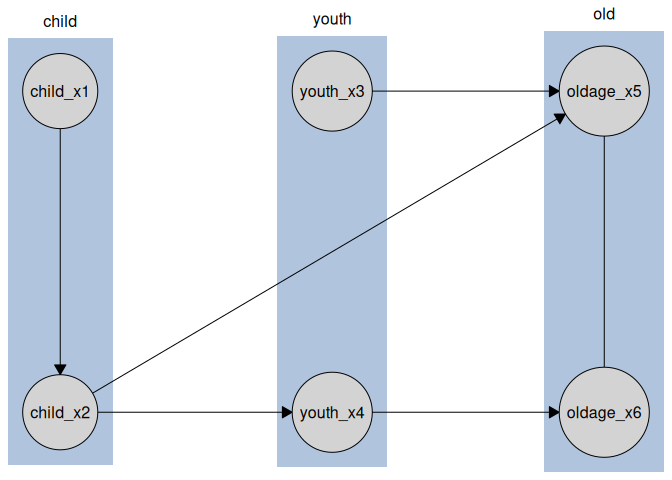
Please see our pkgdown site for more detailed introductions to the package and its features, such as how to incorporate knowledge, run causal discovery, and visualize results, here: https://disco-coders.github.io/causalDisco/